The music behind the evening
Dresden's Music Tradition
From the court orchestra of 1548 and Heinrich Schütz to Wagner and Richard Strauss premieres: the music history that a Dresden concert sits inside.
Reserve a seat in the Wallpavillon ↗Quick answer
Dresden's court orchestra was founded in 1548, Heinrich Schütz came to the Saxon court in 1615, and Weber and Wagner later led the court's music. The city's opera house staged Wagner premieres in the 1840s and Richard Strauss premieres from 1901. The Zwinger concert is played by a different, chamber-sized ensemble, but it belongs to the same musical city.
A court orchestra from 1548
The orchestra now called the Staatskapelle Dresden was created by order of Maurice, Elector of Saxony, in 1548. Heinrich Schütz was associated with it early in its life. He moved to Dresden in 1615 to work as court composer to the Elector of Saxony, and he died there in 1672. His works include the Psalmen Davids of 1619 and the Musikalische Exequien of 1636. Schütz's Dafne, performed at Torgau in 1627, is traditionally considered the first German opera, although its music has been lost. The Musikalische Exequien is called the first German Requiem, and his Passion settings of the 1660s are described as the greatest Passion music before Bach.
Pisendel, Vivaldi and the Dresden orchestra
In the eighteenth century the Dresden court orchestra was led by the violinist Johann Georg Pisendel, who became its concertmaster officially in 1730. Sources describe it as then the finest instrumental ensemble in Europe. In 1716 Pisendel travelled to Venice and spent nine months studying with Vivaldi, and Vivaldi, Albinoni and Telemann all dedicated works to him. That is why Vivaldi sits comfortably in a Dresden programme. Pisendel had joined the orchestra as a violinist in 1704 and returned as leading violinist in 1712, and he had effectively led it since the death of Jean-Baptiste Volumier in 1728.
Weber and Wagner
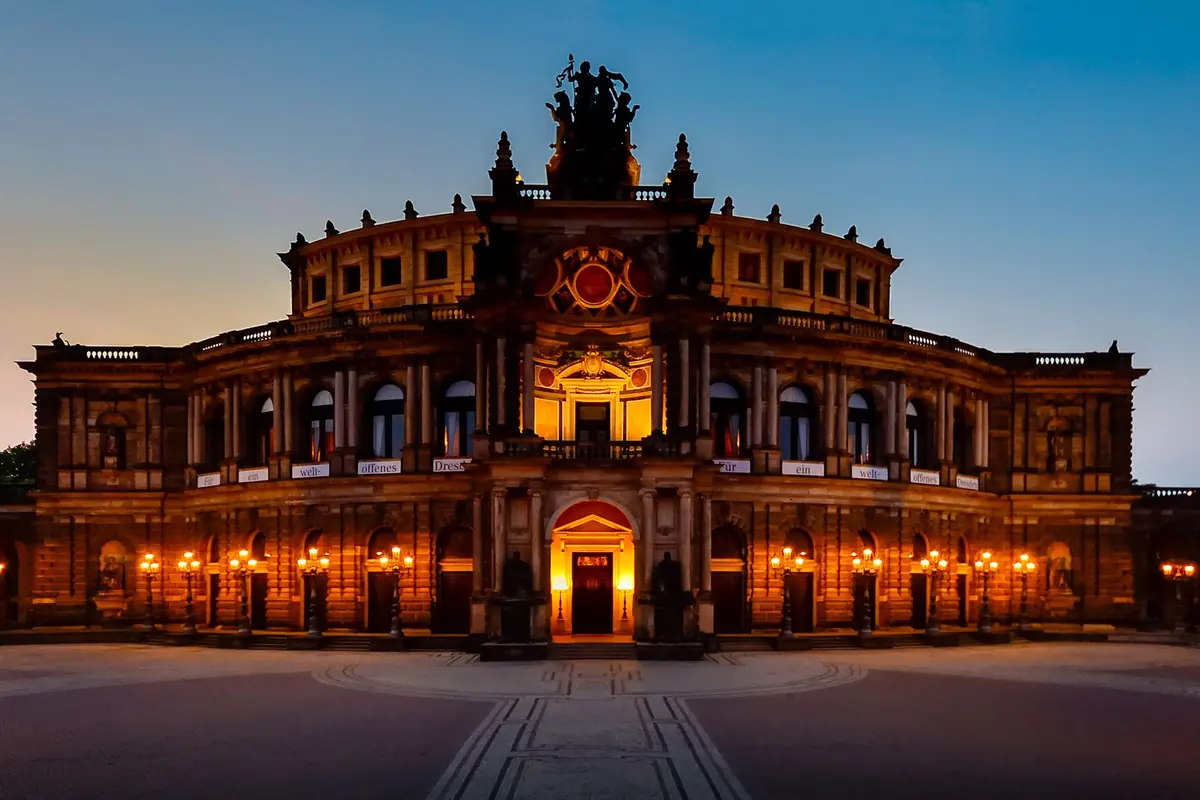
Carl Maria von Weber served as Hofkapellmeister from 1816 to 1826, and Richard Wagner held the post from 1843 to 1848. The Semperoper's own list of premieres includes Wagner's Rienzi in 1842, The Flying Dutchman in 1843 and Tannhäuser in 1845. The first opera house of Gottfried Semper opened on 13 April 1841. Both held the Hofkapellmeister post, Weber for a decade and Wagner for five years.
Strauss and the Semperoper
Richard Strauss became closely associated with the Staatskapelle as conductor and composer, and the orchestra premiered several of his works. The Semperoper's list of premieres includes Salome in 1905, Elektra in 1909 and Der Rosenkavalier in 1911. The building was largely destroyed in the bombing of 1945, leaving only the exterior shell, and reconstruction was completed on 13 February 1985, when the house reopened with Weber's Der Freischütz. The Staatskapelle is a constituent body of the opera house, playing in the pit for opera and on a platform for its own concert series.
The two Semper opera houses
Gottfried Semper designed the first opera house, which opened on 13 April 1841. After a fire in 1869 the building was rebuilt and completed in 1878, and Semper's son Manfred built the second house using his father's plans. The article lists Strauss premieres across four decades: Feuersnot in 1901, Salome in 1905, Elektra in 1909, Der Rosenkavalier in 1911, and later Intermezzo, Die ägyptische Helena, Arabella, Die schweigsame Frau and Daphne, the last in 1938.
Where the Zwinger concert fits
The Zwinger gala concerts are not given by the Staatskapelle. They are played by the Dresdner Residenz Orchester, founded in April 2013 by the violinist Igor Malinovsky, whose line-up varies with the programme from a duo or trio up to an orchestra of 30 to 50 musicians. What the two share is a city: Dresden has staged music in courtyards and halls since the Baroque court, and the Zwinger has hosted serenades since 1928. Vivaldi, Mozart and Grieg, the names on its calendar, are the kind of repertoire that suits a small ensemble.
Read next: Dresden Zwinger Concert: Booking
Who this isn't for
This guide is not a listings page for the Semperoper or the Staatskapelle, whose own programmes are the place to look for opera and symphony concerts. It is background for the evening in the Wallpavillon, and it makes no claim that the Zwinger orchestra is the court orchestra of 1548. Nor is it a ticket guide: the booking details are in the booking guide.
Frequently asked questions
Is the Zwinger orchestra the Staatskapelle?
No. The Staatskapelle is the Semperoper's orchestra. The Zwinger concerts are played by the Dresdner Residenz Orchester.
Why does Dresden have so many premieres?
Its opera house staged Wagner premieres in the 1840s and a series of Richard Strauss premieres from 1901 to 1938.
Sources